
Impact
Impact reflects our social and environmental responsibility, creating positive outcomes for people, communities and the planet. In 2025, we continued to embed sustainability across our operations, making further progress towards our net-zero targets, strengthening our social responsibility and supporting an inclusive and safe workplace. We also engaged actively with stakeholders such as regulators, policymakers, sector associations and civil-society organisations to promote a sustainable postal framework and to help shape the regulatory and societal conditions needed for a low-carbon, accessible and fair postal market.
Our culture is built on clear values that guide behaviour, strengthen collaboration and support sustainable long-term value creation. As part of our broader impact agenda, this culture enables our people to contribute meaningfully to society through safe, reliable and customer-focused services. By fostering an environment in which colleagues feel respected, informed and able to grow, we reinforce the foundation for sustainable operations and positive societal impact.
A healthy, engaged and stable workforce
We continued to work on strengthening workforce stability and long-term employability amid a persistently tight labour market. Although recruitment challenges for mail deliverers remained, conditions improved slightly compared with 2024, particularly for roles that are part-time and physically demanding. Some urban regions continued to face structural shortages despite successfully hiring over 4,000 new colleagues during the year.
In the Netherlands, wage cost pressure continued following statutory minimum wage increases. As a good employer, our goal is to provide decent wages and fair employment conditions for all our people. During the year, we also prepared for upcoming changes in the ABU collective labour agreement (CLA) for temporary workers, which came into effect on 1 January 2026. PostNL is assessing its impact with the aim of reducing dependency on temporary labour and increasing the share of directly employed staff.
In parallel, discussions began with the trade unions on a new CLA for our postal deliverers, with the current agreement expiring at the end of 2025. Our goal is to establish a CLA that offers stability and clarity during a period of significant change and supports progress towards a future-proof postal company. Postal deliverers emphasised the importance of salary, alongside recognition and appreciation for their essential work. We agreed with the unions to continue discussions in early 2026. Ultimately, we share the same objective: ensuring good and sustainable employment conditions within a financially healthy PostNL.
Given the inherent physical nature of many roles across our networks, occupational health and safety remained a top priority. Through ongoing investments in ergonomics, prevention and innovation, we continue to ensure a safe and healthy workplace. We continued our programme to reduce physical workload through mechanisation, task rotation and ergonomic innovation, supported by investments in lifting aids such as tilters. Additional measures included clearer labelling of heavy parcels, testing new tools and closer cooperation with customers to improve loading practices and safe handovers. While early indications suggest positive developments, these efforts are not yet fully measurable, as many relate to processes staffed by temporary workers who, by the nature of temporary employment, tend to have higher turnover and often do not remain long enough for the impact to be reliably measured. However, we expect clearer insights to emerge as monitoring matures. We remain in open dialogue with the Dutch Labour Inspectorate and unions to ensure compliance and safety, as societal tolerance for physically demanding work continues to decline.
This year, we renewed our focus on safety by emphasising the use of mandatory protective footwear at large Mail processing locations in the Netherlands, alongside strengthened first-aid and fire-drill procedures and a renewed emphasis on workplace discipline. To address one of the most frequent accident risks, we ran a national dog-bite awareness campaign for deliverers. We will continue to combine targeted employability initiatives, data-driven health management and a stronger performance culture.
We also established a new Health & Safety organisation on 1 April to further professionalise risk assessment and embed safety structurally into daily operations. This reflects our view that the health and wellbeing of our people come first and that reducing absenteeism starts with a supportive and safe working environment. Managers are being trained to take a proactive approach, including facilitating adjusted duties or reduced hours where appropriate, in line with the Dutch ‘Wet Poortwachter’ requirements.
We continued annual driver training and supported national road-safety initiatives, rolling out awareness tools such as stickers and cyclist protection across the fleet. Although delivery partners are not formally trained, shared awareness materials and our ongoing focus underline that traffic safety remains a long-term priority.
We expanded and strengthened our diversity, equity and inclusion (DEI) networks, including the formalisation of the Cross Culture Community (CCC) and the launch of the Neurodiversity Network. We also continued DEI training across six long-standing priority areas, implementing survey recommendations and maintaining our core learning modules. Despite fewer trainers, an increased subsidy rate helped sustain tailored interventions, while development of a new Cultural Barometer progressed for launch in early 2026. In 2025, the share of women in management positions was 34%, including 26% in operational- and 35% in middle-management roles, reflecting our continued ambition to build a more inclusive and representative leadership structure.
We advanced our campaign on (un)desirable behaviour, strengthening prevention, reporting and incident-management processes across all workplaces. The campaign clarified governance, enhanced awareness and will be followed by dedicated management training in 2026. We also appointed a Human Rights Officer.
Absenteeism remains one of our most significant internal challenges. Absenteeism at PostNL was 8.5%, compared with around 6.3% in the transport and logistics sector. Two factors contribute to this gap: the physically demanding nature of our work and the ageing profile of our workforce. In 2025, we launched the Managing Employability programme (Sturen op Inzetbaarheid), developed together with a third-party adviser, to support a more proactive approach to managing absence. Using data-driven insights, the programme enables a targeted approach to illness prevention, helping us focus on the areas where interventions can have the greatest impact. Looking ahead, we expect the measures introduced under our Managing Employability programme to support a meaningful reduction in absenteeism, strengthening our ability to safeguard a healthy, engaged and sustainable workforce. At Mail in the Netherlands, we succeeded in bending the trend of rising absenteeism by shifting the focus of local management from change initiatives to reinforcing the fundamentals of steady, reliable, day-in, day-out operations.
Turnover among parcel deliverers remains higher than in other roles, reflecting the part-time, physically demanding and often transitional nature of the work. Our focus is therefore on building a more stable core workforce, complemented by flexible capacity where needed, to support continuity and operational reliability.
Since 2016, PostNL has monitored satisfaction and working relationships with delivery partners through the annual collaboration barometer. In 2025, we introduced multiple measurement moments (Q2, Q3 and Q4) and tested different research methods and targeted questions to better capture the impact of system and process changes and to improve response rates. In Q4, feedback was received from 186 delivery partners (38% response rate) and 1,092 parcel deliverers (37% response rate). In the Netherlands, 63% of delivery partners in Q3 reported being (highly) satisfied with PostNL as a client (2024: 62%), while in Belgium satisfaction decreased to 71% (2024: 80%). These insights support improvement actions and will inform the development of an enhanced collaboration barometer in 2026.
Employee engagement is a critical driver of sustainable performance. In 2025, engagement levels averaged 69%, slightly above our goal of 68%. Engagement was measured three times in 2025, with results discussed at both corporate and team levels, and we will increase this to four times in 2026. Managers play a key role in creating a positive working environment. Through regular check-ins and open conversations, they are encouraged to listen, recognise effort and address issues constructively. Across several teams, we also introduced small initiatives to celebrate achievements and strengthen team spirit. In parallel, we advanced Talent Management through the rollout of the ‘Leiderschapskompas’, defining what effective leadership at PostNL looks like today and in the future. This framework is closely linked to our Future Skills programme, currently in the start-up phase, which will focus on developing the competencies needed for tomorrow’s roles. We reviewed our entire talent pipeline to ensure the right people are in the right positions and that development opportunities are aligned with business needs.
Although at an early stage of development, we are building a culture of performance management, where accountability and ownership are central. This cultural shift is not driven by large-scale programmes but through consistent leadership behaviour and practical application. We exceeded our 7.5% target for mail delivery hours performed by people with a distance to the labour market, achieving 7.9% in 2025. The target will be maintained for 2026, with progress continuing to be reviewed twice a year with the works council.
More detailed information on the above topics can be found in the social disclosures within the sustainability statements later in this report.
Fair and equal employment
PostNL strives to have fair and equal employment, irrespective of gender or background, and stands for equal opportunities for all employees. We comply with statutory minimum wage requirements and apply a remuneration policy that does not discriminate on the basis of gender or background. As a company with a clear societal role, we consider it essential to set an example in fair and equal pay and to contribute positively to social impact. We strive for equality, transparency and consistency in our pay policies, which is reflected in our job grading system and salary structure. These are largely embedded in CLAs, which are agreed with trade unions.
The unadjusted gender pay gap reflects the difference between the average gross hourly earnings of male and female employees in the Netherlands. The adjusted gender pay gap provides a more nuanced view, taking into account different CLAs, job levels and age groups. By reporting this adjusted figure, we aim to provide clearer insight into how we ensure equal pay for equal work. In 2025, our unadjusted gender pay gap amounted to 5.93%, compared with 6.67% in 2024, representing further progress. This gap primarily reflects the higher proportion of male employees in higher salary scales. PostNL continues to focus on fostering a diverse working environment, supported by the expansion and strengthening of our DEI networks and the continued rollout of DEI training programmes, including initiatives aimed at increasing the representation of women in senior management and further developing our Women’s Inclusion Network (WIN). After adjustment, the gender pay gap in 2025 amounted to -0.17% (2024: 0.15%), indicating that women and men at PostNL are paid broadly equally. While we welcome this outcome and the positive trend, we continue to conduct in-depth analyses, including in preparation for the upcoming implementation of the EU Pay Transparency Directive. We are actively aligning our processes and policies with this legislation and preparing for enhanced transparency and reporting requirements.
Our vision for a future-proof postal service
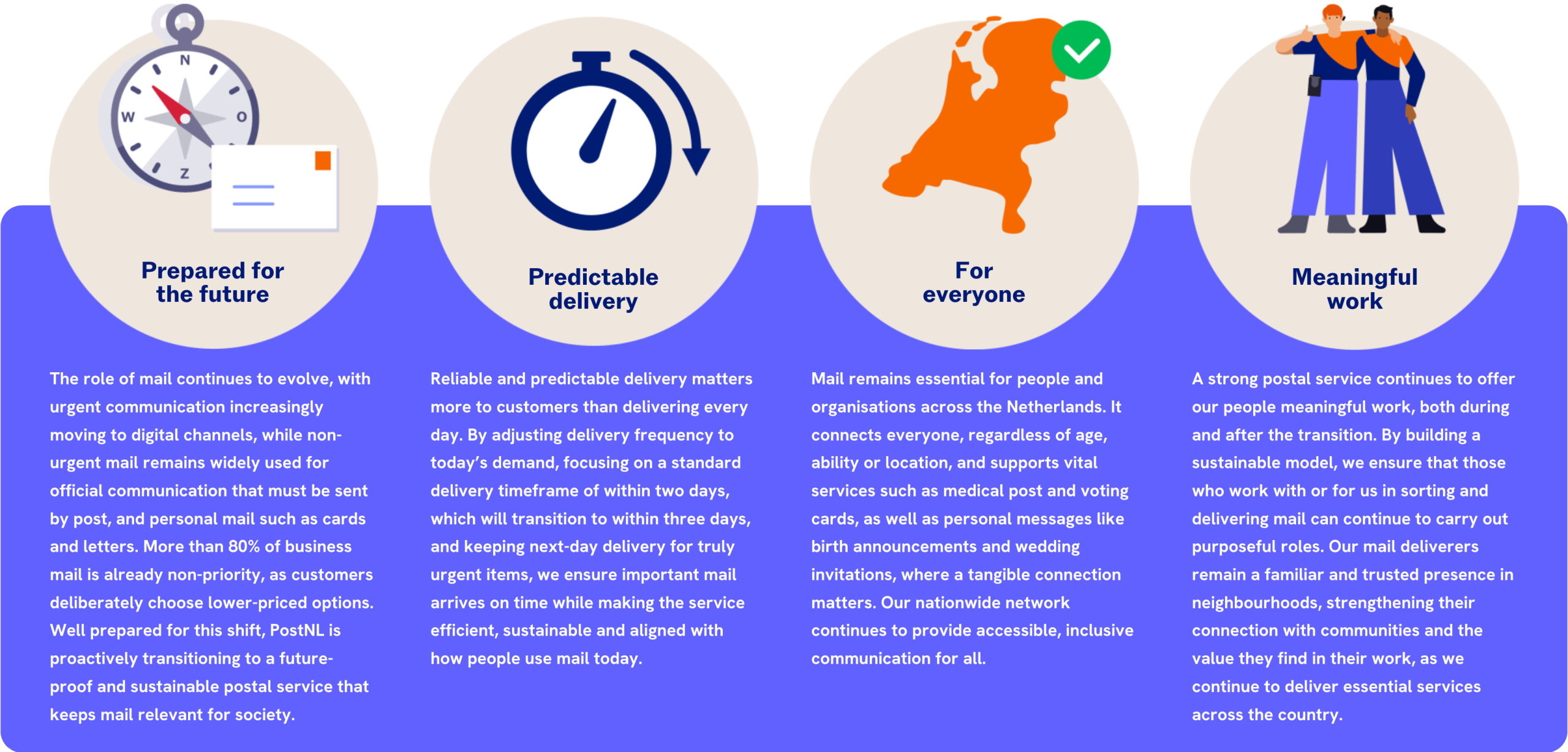
As mail volumes continue to decline, we are working towards a future-proof postal service that remains reliable, accessible and relevant for society, while continuing to create meaningful social impact across the Netherlands. This page outlines our vision for how mail can continue to serve the Netherlands, and the impact we aim to deliver for communities, businesses and society at large, building on the progress achieved internally in 2025. See page ,
Delivery in 2025 describes how our approach is shaped by the requirements of the Postal Act, which define the framework within which we are required to operate. At the same time, we balance our statutory universal service obligations with the need to adapt our operations to safeguard long-term sustainability and to maximise social impact. Realising this vision and the intended impact of our postal service depends on changes to postal regulation, and updates on this topic for 2025 can be found in the Regulatory developments chapter on page Regulatory developments.
Impact through brand and market presence
Throughout 2025, we further strengthened our position as a recognisably Belgian brand, with communications, services and customer touchpoints increasingly aligned with local language and cultural expectations, reinforcing trust and familiarity among consumers and businesses. We enhanced brand visibility through the launch of the ‘Klaar voor je ongeduld’ (Ready for your impatience) campaign, rolled out across radio, television, outdoor and digital channels. The campaign builds on a clear consumer insight: rising expectations for fast and seamless delivery, positioning PostNL as a provider that understands and responds to these needs. By increasing our visibility and competitiveness in Belgium, we support a healthier and more diverse e-commerce market. A stronger PostNL presence contributes to greater choice, higher service standards and competitive pricing for customers and consumers, supporting the effective functioning of the wider Belgian e-commerce ecosystem. Together, these efforts strengthen brand preference and reinforce our broader societal impact in Belgium.
Environmental impact
We are implementing a company-wide transition plan that integrates climate action, liveability and circularity, delivering measurable environmental impact across our operations and value chain. Guided by the Science Based Targets initiative (SBTi), we aim to achieve net-zero emissions by 2040, reducing scope 1 and 2 emissions by 90% and scope 3 emissions by 45% by 2030, while limiting residual emissions to no more than 10%, in support of the EU’s climate neutrality ambition for 2050. Further details are provided in our transition plan in the sustainability statements.
Our transition focuses on the decarbonisation of transport through electrification, the use of renewable fuels and improved network efficiency, primarily addressing scope 1 and scope 3 emissions. In addition, we invest in sustainable infrastructure powered by renewable electricity, contributing to the reduction of scope 2 emissions, as outlined below.
We accelerated decarbonisation by expanding our fleet of electric vans with 50%, as well as growing the number of cargo bikes, directly reducing scope 1 emissions from last-mile delivery. We also stimulate our delivery partners to use electric vehicles, supporting scope 3 emissions reduction. By year-end, 27 Dutch city centres, including Amsterdam’s entire ring area, were served exclusively by zero-emission vehicles. This milestone marks tangible progress towards our 2030 goal of emission-free delivery in the Benelux, covering the last stage from sorting centre to delivery address. By year-end 2025, 33% of last-mile deliveries were zero-emission (2024: 28%).
We further expanded the use of renewable fuels in our own fleet, reducing scope 1 emissions from line-haul transport. We also equipped more depots with batteries and charging infrastructure, supported by enhanced energy monitoring. Other highlights included maintaining near-zero scope 2 emissions through Dutch Guarantees of Origin for electricity. In addition, our ISO 14001 covers 98% (2024: 98%), underscoring the effectiveness of our environmental management system. We also strengthened supplier requirements on CO₂ reduction and environmental certification, supporting progress on scope 3 emissions in our upstream value chain.
While last-mile delivery for Mail in the Netherlands is already largely low-carbon through walking and cycling, in 2025 we continued electrifying routes that still require vehicles. Progress remains partly constrained by external charging infrastructure and local grid capacity, affecting a limited part of the network. We worked with municipalities and network operators to find additional grid connections. Additionally, we prepared for the introduction of kilometre-based road charging in the Netherlands, which will take effect from 1 July 2026. Under this system, lorries over 3.5 tonnes will be taxed per kilometre driven, with rates linked to vehicle weight and emission class. In anticipation, we reviewed our fleet composition, routing efficiency and data systems to ensure smooth implementation and mitigate financial impact. The measure encourages cleaner transport, with zero-emission vehicles paying substantially less, while part of the proceeds will be reinvested to support a more sustainable sector.
Spring Europe launched a new client-facing emissions dashboard, consolidating shipment data and providing customers with clear insights into their carbon footprint, including breakdowns by destination and transport leg. To decarbonise cross-border logistics, we continue to use HVO100 exclusively for European line-haul transport and are exploring opportunities for truck electrification. We are also exploring lower-carbon solutions across the value chain, including the use of Sustainable Aviation Fuel (SAF) for air transport. We apply circular principles across our upstream value chain, progressing towards our ambition of net zero waste by 2040. During the year, we expanded the use of reusable pallet boxes, reducing our reliance on virgin materials. In addition, we enhanced our scope 3 emissions insights to further increase transparency.
We also advanced our downstream circularity efforts by supporting re-commerce, repair, reuse and recycling, introducing solutions for e-waste and textiles, piloting reusable packaging and deepening sector collaboration through Circular Shopping 2030 and partnerships such as Dobbi. These initiatives form part of a 2025–2030 strategy to scale circular business models, expand material recovery and strengthen cooperation with retailers and technology partners. We also continued working towards our ambition of no more than 10% residual waste by 2040 by conducting site-level waste scans and developing a multi-year reduction roadmap. Clearer sorting systems, an internal awareness campaign and enhanced dashboard monitoring supported resource optimisation across depots, sorting centres and offices.
More detailed information can be found in the environmental disclosures within the sustainability statements.
Impact along the value chain
Our collaboration with social partners and suppliers focused on improving working conditions across the value chain. Where we rely on contracted delivery partners, we supported them with safety guidance and materials to promote consistent standards.
In 2025, we carried out a Human Rights Salience Assessment to systematically identify and prioritise the areas where PostNL has the highest potential to impact people’s rights across our operations and value chain. This assessment ensures that we focus on the issues that are at risk of the most severe negative impact through our activities and business relationships. Among these salient risks are fair working conditions, workload pressures, and safe employment practices within our delivery partner networks. We will continually explore opportunities to further enhance our due diligence practices in 2026, taking into account evolving regulatory expectations, including the upcoming Corporate Sustainability Due Diligence Directive (CSDDD) as well as our broader sustainability ambitions.
We also strengthened grievance mechanisms and remediation efforts ensuring that employees and delivery partners can raise issues safely and confidentially. Oversight of delivery partners was expanded through due diligence assessments and follow-up audits, helping us to identify risks at an earlier stage and take corrective action where needed.
We set clear expectations for employees, delivery partners and suppliers, supported by training, audits and our Third-Party Risk Management (TPRM) tool. In 2025, we strengthened implementation by embedding clear delivery guidelines across our business segments in the Netherlands and Belgium, and by further rolling out the TPRM tool to different parts of the company, supporting greater consistency and transparency in our supply chain.
More detailed information on the above topics can be found in the social disclosures in the sustainability statements.
Community impact
In 2025, we again used our nationwide network to connect people, communities and moments that matter.
Special Moments Fund
The Special Moments Fund is financed by PostNL, with our multi-year commitment extended through 2028, and focused on people in need of extra support, building on our presence in every neighbourhood. During the year, we expanded the 'Ik maak me zorgen' (Raising a concern) initiative nationally, enabling deliverers to voluntarily and anonymously report concerns about residents to local welfare organisations. By year-end, we had partnerships with organisations in around 95% of Dutch municipalities, totalling more than 330, and deliverers raised close to 1,000 concerns. Welfare organisations report that many residents received help they would otherwise have missed, and the programme has attracted interest from parties wishing to adopt a similar model.
The fund also used our network to support charities promoting inclusion and wellbeing. Together with Stichting Jarige Job, we delivered birthday boxes for children in low-income families, supported by a consumer toy-collection campaign and a parcel-locker initiative that triggered a €250,000 donation from the fund. With the Nationaal Ouderenfonds, schoolchildren created around 212,000 Christmas cards that PostNL delivered to older people who may feel lonely.
We again enabled the nationwide Kinderpostzegels campaign by providing free logistics for participating schools. We have made a new stamp sheet of which 568,000 were sold. These were being sold by 120,000 primary schoolchildren for the benefit of other children.
Our deliverers continued to show their community involvement by greeting people, stopping for brief conversations or posting personal cards.
In 2025, they distributed an estimated 170,000 cards offering congratulations, condolences or encouragement, gestures funded by the fund but carried out voluntarily by our people, and a distinctive expression of our social role. To further support employee engagement, the fund awarded 150 donations of €250 to local clubs and organisations where colleagues volunteer, helping finance items such as team kits and shared equipment.
Proud sponsors of Team Picnic PostNL
We proudly continued our partnership with Team Picnic PostNL, following a year of strong sporting results and growing visibility in the Netherlands and Belgium. Since 2025, Picnic has been co-title sponsor and the team has officially competed as Team Picnic PostNL, providing a strong platform to translate the partnership into concrete engagement and activities for our employees and customers, wherever possible. Examples include enabling customers to hand in PostNL returns via Picnic delivery drivers and, during the festive period, offering the option to send Christmas cards through Picnic deliveries, illustrating how the collaboration between the two co-title partners takes shape in practice.
In 2025, both the men’s and women’s programmes operated under the same minimum-wage structure for the first full season, a milestone that reflects our shared commitment to fairness, inclusion and progress in professional sport. Employee engagement also remained a key focus, with cycling-loving employees participating in cycling events such as the Amstel Gold Race, attending races to support the team and contributing operational support where appropriate. In addition, customer events were organised around major cycling races, further strengthening engagement and connection.
The team also expanded its community activities, promoting healthy lifestyles and encouraging cycling, reinforcing our support for vibrant, resilient communities.