1.1 Our integrated business model, strategy and value chain
Our business model is designed around helping customers grow, creating more value by supporting them at every step of the logistics chain. By optimising every stage of this chain, we ensure that each interaction contributes directly to a better customer experience and greater overall value. This model also shapes how we identify, prioritise and manage the impacts, risks and opportunities (IROs) arising from our activities, relationships and dependencies across the value chain. For a detailed explanation of these steps, see pages Our value chain- in the Our operating context chapter.
In September 2025, we introduced Breakthrough 2028, our strategic plan that sets PostNL’s course towards 2028 and beyond, building on our strong heritage while accelerating our transformation as a leading e-commerce and logistics company. Anchored in our purpose, Connected to deliver what drives us all forward, our integrated strategy clarifies how we create long-term value in a dynamic and increasingly digital environment: in E-commerce, by shifting from volume to value through a differentiated approach and smart use of our network; in Platforms, by capturing selective international growth through asset-light models; and in Mail, by transforming towards a future-proof postal service.
Guided by our North Star and our values, and focused on the four pillars of Growth, Value, Innovation and Impact, we strengthen our competitive position, drive operational excellence and innovation, and deliver positive social and environmental outcomes for our people, customers, shareholders and society. This integrated approach underpins our business model and value chain and ensures that PostNL remains relevant, responsible and the favourite deliverer for everyone we serve. Detailed information on how we aim to realise our purpose and ambition through our strategy, as well as an explanation of our business model, can be found in the Our strategy chapter.
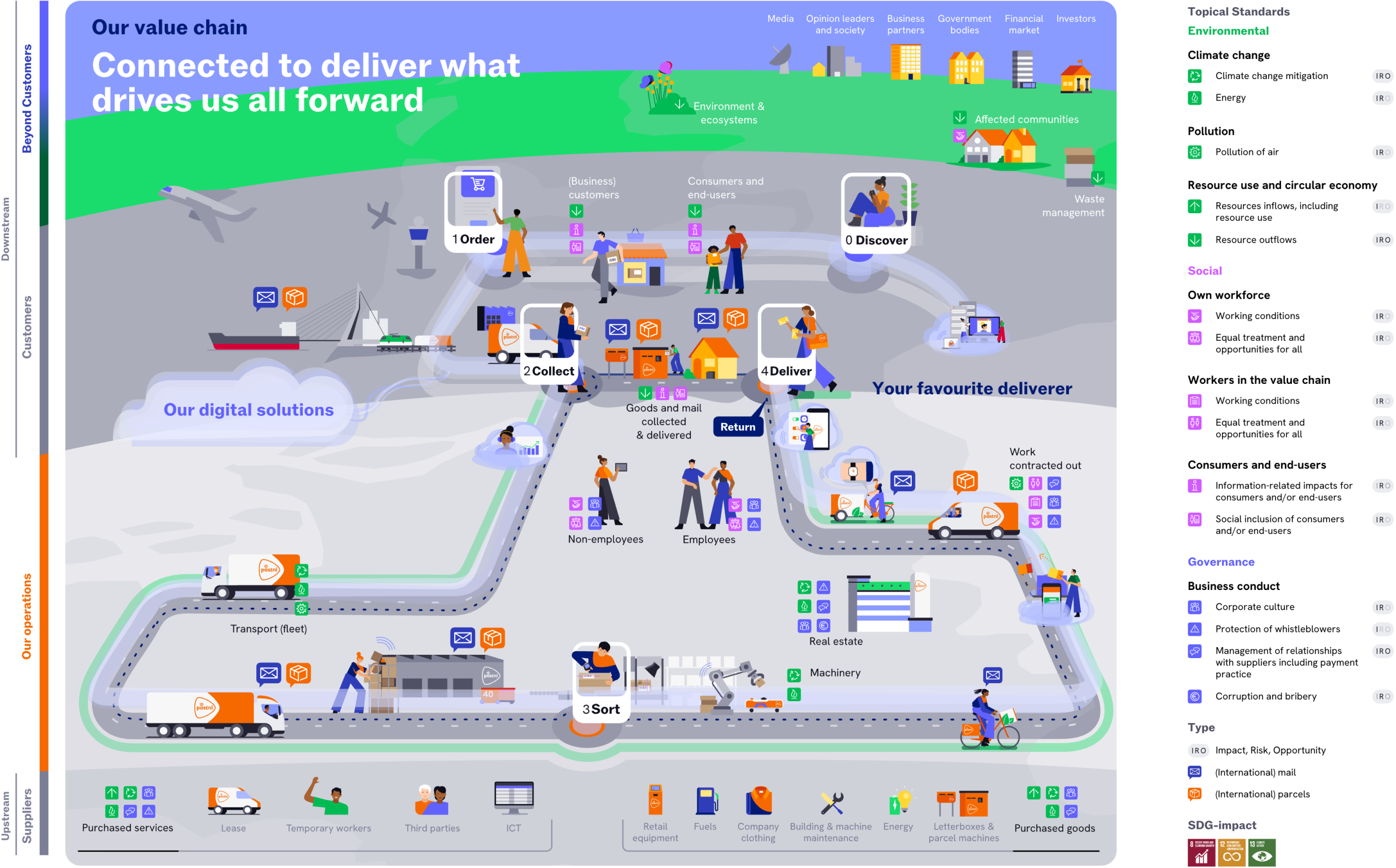
The context in which we operate, including our position and role within the value chain, market developments, and engagement with stakeholders such as shareholders, customers, employees, delivery partners and suppliers, is illustrated in Our value chain infographic on the next page. The infographic provides an overview of the logistics process, shows how we connect with business customers, consumers, and end-users, and highlights the Corporate Sustainability Reporting Directive (CSRD) topical standards most relevant to our operations and stakeholders.
It also maps our material environmental, social and governance topics and shows where IROs arise across the value chain. This underscores the central role of our double materiality assessment (DMA) in linking our strategy and business model to our impacts on society and the environment, as well as the financial risks and opportunities that affect PostNL. More information on the logistic process in the value chain is provided in the Our operating context chapter on page Our value chain. Details on policies, actions, targets and metrics related to the material topics are included in the Environmental, Social or Governance (ESG) disclosures.
Our value chain assessment covers both direct and indirect relationships. Direct relationships include suppliers, employees and partners, while indirect relationships reflect broader influences on our operations. Upstream activities relate to fuels, packaging, energy and services, while downstream activities relate to the delivery of products and services and their impact on customers, consumers, end-users and the environment. Across upstream, own operations and downstream activities, we assess IROs over the short, medium and long term, supporting strategic decision-making and risk management.
Interaction of material topics with our business model and strategy
At European Sustainability Reporting Standards (ESRS) level, our material topics capture the key environmental, social and governance IROs linked to our business model and strategy. Environmental topics primarily relate to climate change mitigation, energy use, pollution, and resource use and circular economy. Social topics focus on working conditions, health and safety, equal treatment and inclusion, and impacts on our own workers, consumers and end-users. Governance topics address corporate culture, ethical conduct, whistleblower protection, supplier relationships and the prevention of corruption and bribery, supporting trust, compliance and long-term value creation. For each material topic, we identify relevant IROs, indicate where they occur in the value chain and assess their time horizons. These are managed through our policies, actions, targets, metrics, strategy and governance structures, ensuring consistency and connectivity between the sustainability statements and the broader management report. The entity-specific Key Performance Indicators (KPIs) reflect how we delivered on our strategy across our social and environmental priorities during the year.
The ESG disclosures include overview tables summarising relevant IROs, their link to our business model, location in our value chain and their time horizons. These tables support the cohesion of our sustainability information and act as an entry point for understanding how sustainability considerations are embedded in our strategy and operations. The subsequent sections of the ESG disclosures provide a more detailed explanation of how these IROs are embedded within and connected to our strategy, for example, through our policies, actions, targets and metrics.