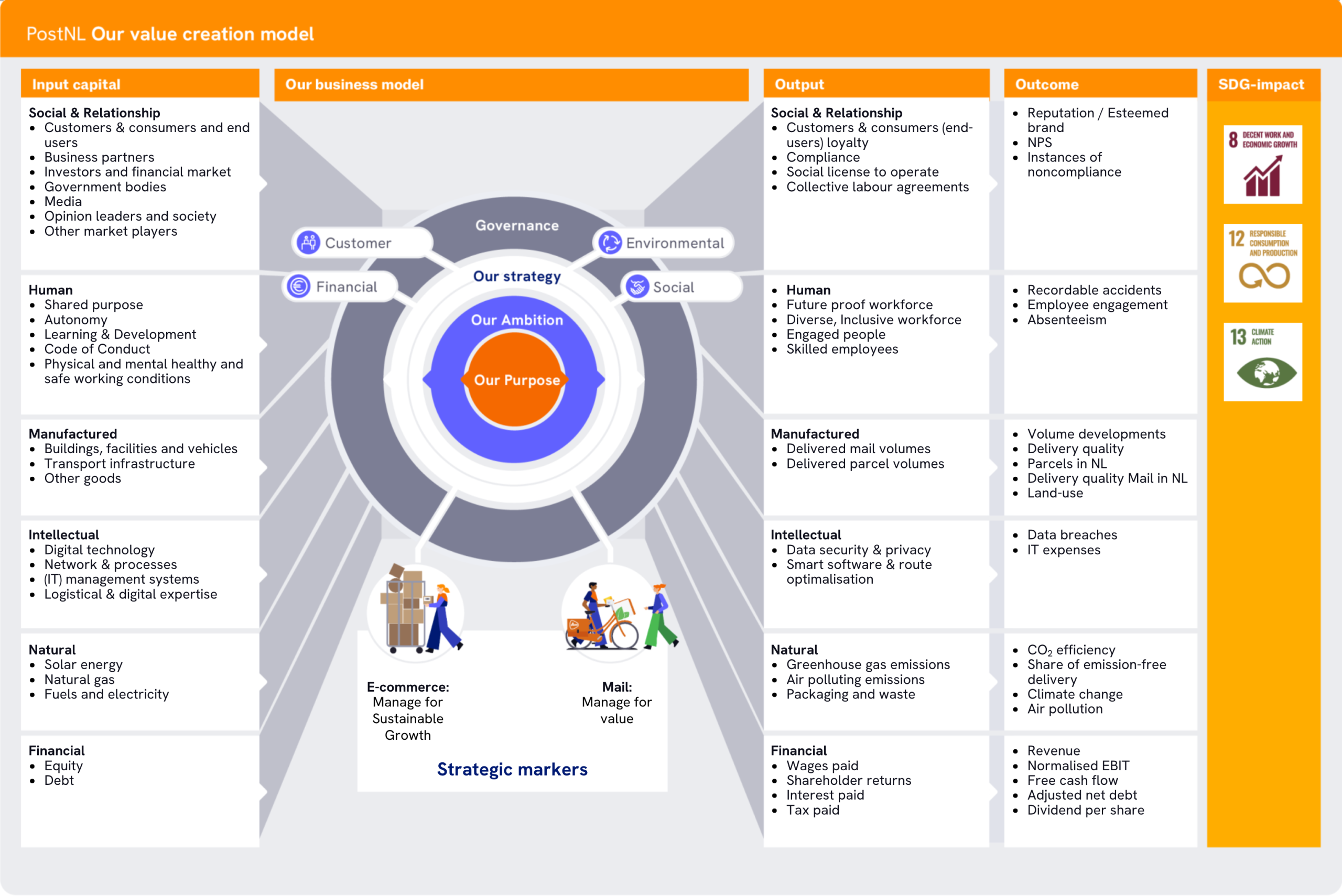
7 Our value creation model
We make use of a range of resources to carry out our business model and convert these into outputs, creating value for the company and our stakeholders. The capital categories are aligned with the International Integrated Reporting Framework of the International Integrated Reporting Council (IIRC). All capitals are interrelated and business activities often require the use of a mix of capital. We aim to allocate our resources based on these capitals effectively by maximising their potential value and minimising their negative impacts as part of our continuous drive to improve.
Social and relationship capital
We have deep roots in society, and through our operations connect with millions of people and organisations on a daily basis. The relationship we have with our stakeholders, especially customers, consumers and end-users, our people, business partners, investors and financial markets, external bodies, media, opinions leaders and society, and other market players influences our ability to create value over time. We strive to build strong relationships by engaging on relevant topics and collaboration based on stakeholder needs.
Human capital
PostNL is a people company. Our human capital refers to the expertise of our people, which is used to provide customer, social, environmental, and financial value. Intellectual capital is the knowledge and skills that are present within PostNL that we use to create value across society. Our people execute our strategy and ensure the delivery of our services. This includes our own employees and people working for us through collaboration with logistics partners. They help us create, maintain and improve our state-of-the-art networks, smart processes and management systems.
Intellectual capital
By operating and developing an inclusive organisation, we aim to help our people to grow, while providing favourable labour conditions, including a safe and healthy work environment. The collective knowledge and experience of PostNL, our intellectual capital, has been built over the course of more than two centuries and is one of our greatest assets. As part of our digital transformation, we are investing in the digital DNA and expertise of our people. At the same time, effective collaboration with our logistics partners is crucial for our success and we continually look for ways to improve our labour practices, particularly in the area of social laws and regulations.
Manufactured capital
Manufactured capital are those goods and assets that enable us to carry out our role as an e-commerce and postal service provider, such as vehicles, buildings and machinery. We select these goods and assets based on our specific needs and available more sustainable options.
Natural capital
Natural capital is the energy we use to provide our services. We are switching to renewable fuels and e-vehicles to reduce our environmental impact, and phasing out fossil fuels as quickly as is feasible. We use solar energy to generate electricity, while we are reducing our consumption of natural gas in operating our buildings. Fossil fuels produce greenhouse gases (GHG) and air-polluting emissions that contribute to climate change and impact air quality.
Financial capital
Shareholders and other relevant players in capital markets, such as bondholders and banks, provide PostNL with funds used to invest in our assets and operations. We use this financial capital to operate and grow our business and generate sustainable growth and cash flow, thereby creating long-term value for us and our stakeholders.
Sustainable development goals
We continue to embed the UN Sustainable Development Goals (SDGs) across our strategy and value chain, as they support our aim of making a positive contribution to people, the environment, and society. By linking our material topics to the SDGs, we provide a clear framework to measure our contribution to global sustainability challenges and align our policies with international targets. The three SDGs on which we can make a real difference are:
- SDG 8 – decent work and economic growth: safe working conditions, equal opportunities, personal development and respect for human rights
- SDG 12 – responsible consumption and production: sustainable working and reporting transparency
- SDG 13 – climate action: CO2 reduction and embedding, climate measures in policy and strategy.
For a further explanation of these three SDGs, please see section Basis for preparation in the General disclosures of the Sustainability statements.