
2.1 General disclosures
2.1.1 Our impacts, risks and opportunities
In the table below, we disclose our material impacts, risks, and opportunities per topic, including their time horizon and where in the value chain they occur.
Description | IRO | Value chain | Time horizon | |
|---|---|---|---|---|
Climate change | ||||
| Climate change mitigation | |||
Potential contribution to global warming due to direct and indirect GHG emissions from (packaging) waste arising from both parcels and mail (potential). |
|
|
| |
Contribution to global warming due to direct and indirect GHG emissions (actual). |
|
|
| |
Increased costs due to carbon taxes (2+ years) and revenue loss resulting from outperformance by competitors or customer exclusion. |
|
|
| |
Risk of volume loss due to import restrictions for non-EU customers in relation to CO2 and circularity targets. |
|
|
| |
PostNL can demonstrate its commitment to addressing biodiversity loss by leveraging its resources including buildings and parcel lockers, to support local ecosystems, inspiring both businesses and consumers to take similar action; moreover, access to land and opportunities is increasingly reserved for companies actively engaged in biodiversity conservation efforts. |
|
|
| |
| Energy | |||
Reduce energy demand from the grid through on-site renewable energy production and improved network efficiency. PostNL contributes to a more sustainable energy mix in the Netherlands (actual). |
|
|
| |
Costs associated with the transition to renewable energy and the broader impact of rising energy prices. |
|
|
| |
Pollution | ||||
| Pollution of air | |||
Particulate matter and nitrogen oxides negatively impact air quality within the wider community and environment (actual). |
|
|
| |
Potential financial risks arise if compliance and air quality targets are not met. Stricter upcoming air quality standards may require substantial investments to maintain fleet operations, with the added risk of limited vehicle availability. |
|
|
| |
Resource use and circular economy | ||||
| Resource inflows, including resource use | |||
Resource use in daily operations (actual). |
|
|
| |
| Resource outflows | |||
PostNL offers a packaging range that includes cardboard boxes, envelopes, and shipping bags in various sizes and materials (actual). |
|
|
| |
Destruction of returned/refused goods from international customers, offered as a service by Cross Border Solutions (CBS). |
|
|
| |
To address resource scarcity, the EU aims for 50% circularity by 2030. Both consumers (demand) and producers (supply) must adopt circular principles. PostNL has an opportunity to lead and gain market share by meeting the demands of a circular economy. |
|
|
| |

















|
|
|
|
|
|
|
|
|
|
 Short term
 Medium term
 Long term
2.1.2 Our strategy
Sustainability remains core to our updated strategy, supporting our ambition to create impact that matters for people, the environment and society. We continue to integrate climate change, liveability and circularity into our transition plan, with each initiative designed to deliver environmental and societal value. Aligned with our strategic pillars of Growth, Value, Innovation and Impact, we embed sustainability into key business decisions, ensuring that environmental responsibility and operational performance go hand in hand. Anchored in science-based targets and our pathway towards net-zero, we track progress through transparent, data-driven KPIs and invest in scalable, low-carbon technologies that support our ambition to be the favourite deliverer, connecting people, businesses and society in a sustainable way.
Climate risk analysis
Scenario analysis framework
Our resilience analysis incorporates climate-related scenario analysis to evaluate both risks and opportunities across our business. By combining localised geospatial data with macro-level climate and policy trends, we are able to assess physical risks such as extreme weather, flooding and heat stress, while also factoring in national adaptation measures, regulatory developments and shifts in the energy market. This approach not only highlights potential vulnerabilities in critical infrastructure, but also opportunities such as fleet electrification and renewable fuels, ensuring our strategy remains aligned with both global and national climate pathways.
Use of climate scenarios
Our climate scenario analysis is based on the 2023 climate scenarios developed by the Royal Netherlands Meteorological Institute (KNMI), which are aligned with international scientific standards and the goals of the Paris agreement. In 2025, we updated our climate risk assessment and applied these latest KNMI scenarios and geospatial data to ensure that our analysis reflects the most recent scientific insights. These scenarios provide a range of potential futures:
- A low-emission pathway (L), aligned with the objectives of the Paris Agreement to limit global warming to well below 2°C and aiming for approximately 1.7°C by 2100
- A high-emission pathway (H), which assumes continued global emissions growth until 2080, resulting in approximately 4.9°C of warming by 2100.
By applying both trajectories, we assess how different climate futures could affect our operations and long-term strategy. Transition risks are assessed under the low-emission pathway, reflecting rapid decarbonisation, stricter regulation and changing customer expectations. Physical risks are assessed under the high-emission pathway, reflecting more acute physical impacts such as stronger storms, flooding and heat stress. The inclusion of the KNMI high-emission pathway ensures that at least one high-emission scenario is explicitly considered.
Scope of the assessment
For this assessment, we focus primarily on PostNL’s operations in the Netherlands and Belgium, where our high-value assets, activities, and workforce and potential financial exposure to physical climate risks are most concentrated —and where our environmental footprint is most significant. Activities in other countries currently do not involve assets with material exposure and are therefore not assessed separately. While the current analysis emphasises the domestic context, it already incorporates an international perspective, acknowledging that climate risks and market dynamics increasingly transcend national borders. Future iterations will broaden the scope to include key European markets and cross-border operational dependencies.
Critical assumptions
Our analysis is built on a number of assumptions about the transition to a low-carbon and climate-resilient economy. These include rising carbon prices, shifting trade patterns and stronger incentives for renewable energy; a gradual shift from fossil fuels to solar and wind; and advances in sustainable transport, battery efficiency and biofuels that will reshape logistics.
Four-step climate risk assessment
Climate risk assessment is embedded within our Enterprise Risk Management (ERM) framework and follows a four-step process:
- Risk long-list identification: Defining potential risks, including acute hazards (storms, flooding, heat stress) and chronic impacts (temperature rise, sea level change)
- Structured assessment: Internal experts and external data (e.g. national geospatial tools) are used to evaluate likelihood and severity
- Executive review: The Executive Committee (EC) prioritises climate risks within the broader business risk portfolio
- Action plan development: Targeted initiatives address gaps, focusing on fleet electrification, renewable energy sourcing, and site-level resilience measures.
This iterative process ensures our strategy adapts to new data, regulatory changes, and technological advancements.
Results of the analysis
Our analysis shows that chronic risks, such as long-term temperature rise and sea-level change, are unlikely to materially affect operations before 2050. However, acute physical climate risks are already relevant. These include heavy rainfall and extreme precipitation, which may lead to local flooding, water infiltration and temporary disruption of operations, as well as heatwaves, which can cause heat stress in buildings, reduced productivity, and health impacts for employees.
Such events may result in temporary delivery disruptions, increased absenteeism, and additional costs related to repairs, insurance and preventive measures. These risks are currently manageable and are mitigated through a combination of national adaptation measures, PostNL’s business continuity planning and site-level protections implemented at vulnerable locations.
Transition risks are more immediate. Higher costs from carbon taxes, compliance with stricter CO₂ emission and air quality, and the risk of reputational damage if performance lags behind customer expectations represent the most significant transition challenges. The KNMI 2023 low-emission pathway highlights these transition risks and opportunities under a Paris-aligned scenario, while the high-emission pathway provides insight into physical risks such as more frequent storms, flooding and heat stress.
Importantly, PostNL has not identified any assets or activities that are incompatible with a transition to a climate-neutral economy, nor any requiring disproportionate effort to achieve compatibility. In addition, PostNL has not identified any climate-related constraints on access to finance, nor any need for large-scale asset redeployment or workforce re-skilling as part of the transition, as climate risks are managed within existing governance and investment frameworks.
Evaluating greenhouse gas emission sources
We screen our operations and value chain for greenhouse gas (GHG) emissions across scopes 1, 2 and 3, including direct emissions from fuel combustion, indirect emissions from purchased electricity and district heating, and value-chain emissions from third-party logistics, commuting and purchased goods and services. Future emissions are assessed in light of business growth, supply chain changes and climate-related factors. This long-term approach anticipates emissions changes over time and ensures alignment with strategic goals. Certain upstream scope 3 emissions are not yet fully assessed due to data limitations and will be revisited in future analyses.
Areas of uncertainty
Some uncertainties remain, particularly around physical risk hotspots for flooding and extreme weather, as well as the pace of regulatory change, societal preferences and technology adoption. These are addressed through flexible action plans and continuous monitoring aligned with the strategy to minimise exposure to these risks.
Financial effects and mitigation actions
Anticipated financial effects:
- Physical risks are expected to have limited financial impact due to national adaptation measures and PostNL’s site protections
- Transition risks require investment in electrification, renewable energy and compliance with regulations.
Mitigation actions:
- Fleet decarbonisation – accelerated adoption of electric vehicles and renewable fuels
- Renewable energy – transitioning facilities to solar power
- Monitoring and continuity – ongoing location-level monitoring, policy adjustments, and continuity management
- Stakeholder engagement – close collaboration with regulators, suppliers, and customers.
Conclusion
The Climate Risk and Resilience Assessment confirms that PostNL is resilient under both low- and high-emission scenarios. Physical climate risks are manageable in the short to medium term, but require continued monitoring and adaptive measures to prevent future operational and financial impacts. Transition risks, while more immediate, are actively managed through our sustainability strategy, fleet electrification, renewable energy use, and emission reduction programmes.
PostNL will continue to refine its climate risk assessments as new scientific insights become available, particularly following future KNMI updates, and will identify additional mitigation measures where needed. This ensures that climate-related risks and opportunities remain an integrated part of our strategic planning, investment decisions and CSRD reporting.
Transition plan
In our approach to sustainability, climate action, liveability and circularity remain deeply interconnected. Every initiative in our transition plan addresses these three material themes in an integrated way. For example, by electrifying our fleet and increasing the use of renewable fuels, we reduce CO₂ emissions and improve air quality. At the same time, investments in reusable packaging and circular materials reduce waste and lower carbon emissions across the supply chain.
By linking these themes, we ensure that our sustainability efforts are both comprehensive and measurable, addressing the broader environmental challenges we face as a society. This holistic approach, guided by science-based targets and supported by continued investment in cleaner technologies, underpins our progress towards net-zero and a more sustainable logistics network.
Climate change: Net-zero by 2040
We are committed to net-zero carbon emissions by 2040, in line with the Science Based Targets initiative (SBTi) and the Paris Agreement. From a 2021 baseline, we aim to reduce scope 1 and 2 emissions by 90% and scope 3 emissions by 45% by 2030, and to achieve a 90% reduction across all scopes by 2040, with no more than 10% of residual carbon emissions remaining. Looking further ahead, we are exploring options to neutralise residual emissions through permanent carbon removal solutions.
Our footprint analysis confirms that most emissions stem from transport, supported by additional impacts from procurement, business travel, and waste.
Liveability: reducing air pollution and easing congestion
Beyond reducing carbon emissions, we are committed to lessening our impact on air quality and urban liveability by cutting traffic-related pollution and congestion. By 2030, our goal is to achieve emission-free delivery in the last mile, from the last sorting activity before distribution to the final destination. This will eliminate CO₂, nitrous oxides and particulate matter emissions from combustion engines. We are making progress in a number of areas, including introducing zero-emission vehicles and expanding the number of alternative delivery points, thereby shortening delivery routes and reducing emissions in densely populated areas.
Circularity: working towards zero waste by 2040
We are committed to achieving net zero residual waste by 2040, focusing on the circular use of materials across our operations and value chain. Our goal is a 90% reduction in residual waste, ensuring no more than 10% is non-recyclable or cannot be repurposed. By extending the lifespan of products, reducing single-use materials and sourcing more sustainably, we are making tangible progress towards a circular economy.
Decarbonisation levers
To achieve our decarbonisation goals, we focus on the following levers:
- Electrification – rolling out electric vans, trucks, and bikes with charging infrastructure to deliver all letters and parcels emission-free in the Benelux by 2030
- Renewable fuels – using HVO100 and other alternatives to reduce emissions from heavy transport
- Network efficiency – reducing kilometres driven by bundling deliveries, optimising routes, and expanding parcel lockers
- Sustainable infrastructure and energy – building BREEAM-certified depots with solar panels, battery storage, and energy-efficient systems, and sourcing 100% renewable energy
- Circular economy – achieving zero residual waste by 2040 through circular procurement, waste reduction, and reverse logistics models developed with customers.
Funding our transition
Our sustainability actions depend on financial resources, ensuring we meet climate targets while balancing financial feasibility. The current financial pressures mean that we need to carefully balance our sustainability ambitions with financial feasibility, ensuring that we make the most effective use of available resources while staying focused on our long-term climate goals. We align our environmental and financial strategic plans to fund emission-reduction initiatives. Achieving emission-free last-mile delivery by 2030 requires significant investment in infrastructure, vehicles, power supply, and delivery partner engagement.
Our Green Bond programme finances climate-related investments, such as electric vehicles, sustainable buildings, and renewable energy. An overview of payments related to climate investments can be found in our Green Bond Report, which provides transparency on how we allocate funds to support sustainable initiatives.
The net proceeds of our Green Bond are being used to finance and/or refinance new and/or existing eligible green projects. The eligible green projects focus on green kilometres, sustainable buildings, and innovation and efficiency. During the tenor of the Green Bond, the company will annually publish a separate Green Bond Report in line with the framework until an amount equal to the net proceeds of the Green Bond has been allocated to the eligible green projects. On 4 April 2025, we published our sixth Green Bond Report on our website.
Alongside our Green Bond, climate-related initiatives, including zero-emission logistics and innovative technologies, are also funded via our outstanding Schuldschein loans, our Sustainability Linked Bond and our ordinary Bond. The use of proceeds of these instruments is for general corporate purposes.
A second key enabler, which underscores our focus on sustainability and accelerates our transition towards becoming a truly sustainable e-commerce logistics service provider, is our Sustainability-Linked Financing programme, based on our Sustainability-Linked Financing Framework, published in 2024. This framework is designed to provide the financial resources required to achieve PostNL’s strategic objectives, including its SBTi objectives for 2030. In 2025, we issued a €300 million Sustainability Linked Bond.
While we are well-positioned to pursue our sustainability targets, access to affordable capital and maintaining sufficient financial resources remain critical. Any increase in financing costs or reduced access to capital could impact the pace of implementing the technologies and infrastructure essential for achieving our sustainability goals. We actively monitor our financial position and market conditions to ensure we can fully execute our commitments and maintain our progress towards becoming a sustainable logistics provider. To secure sufficient financial resources we issued Schuldschein loans and an ordinary Bond in 2025.
More information on the issued Sustainability Linked Bond can be found on page in the chapter PostNL on the capital markets, on page 4.5 Financial instruments in note ‘Financial Instruments’, Eurobonds’ in the financial statements and the Sustainability-Linked Financing Update in section CSRD governance in the General disclosures earlier in these sustainability statements.
While these investments are key to our climate transition plan, its financing is not directly linked to activities under the EU Taxonomy or investments in the financial statements. For example, investments in fleet electrification—such as leasing electric vehicles— classify as capital expenditures (capex) under the EU Taxonomy and new leases in the financial statements, while the climate investments are based on lease payments. No fixed or fully quantified forward-looking investment envelope is defined at this stage.
Locked-in greenhouse gas emissions
Based on insights from our logistics sustainability experts, we have assessed the risk of locked-in GHG emissions from our key assets and products, considering technological developments and emission reductions across the supply chain. We conclude that there are no significant locked-in emissions in our sector. However, air transport remains a major challenge due to the limited availability and high cost of alternatives such as Sustainable Aviation Fuel (SAF), which can reduce emissions by up to 80%, but is not yet fully scalable and does not deliver zero emissions.
EU Taxonomy
PostNL reports on the EU Taxonomy but has no specific plan or objective to increase alignment. Our decarbonisation efforts focus on fleet electrification. Although we do invest in electric vehicles alignment will not be achieved due to the tyre-requirements of the EU-taxonomy criteria. PostNL expects its alignment with the provisions of Commission Delegated Regulation (EU) 2021/2139 to evolve over time, including the consideration of key performance indicators, such as taxonomy-aligned revenue, capex, and capex plans, as required by Article 8 of Regulation (EU) 2020/852. However, the activities that are currently aligned with the EU Taxonomy are not part of our ongoing transition plan, as they already meet the sustainability criteria set out in the regulation. PostNL is not excluded from the EU Paris-aligned, and reports in alignment of the EU Paris aligned Benchmarks.
Integration and progress
Our climate transition plan is fully embedded in our strategic planning and control cycle. This ensures that sustainability considerations are integral to investment decisions, capital allocation and risk management. Reducing GHG emissions, including achieving emission-free last-mile delivery by 2030, remains central to our Breakthrough 2028 strategy.
We track progress through defined performance indicators and continuous evaluation of risks and opportunities in a dynamic environment. The plan is validated by the Executive Committee and overseen by the Board of Management, ensuring accountability and alignment with our science-based targets and long-term strategic goals. More information can be found in the Performance sections later in this chapter.
Climate transition plan
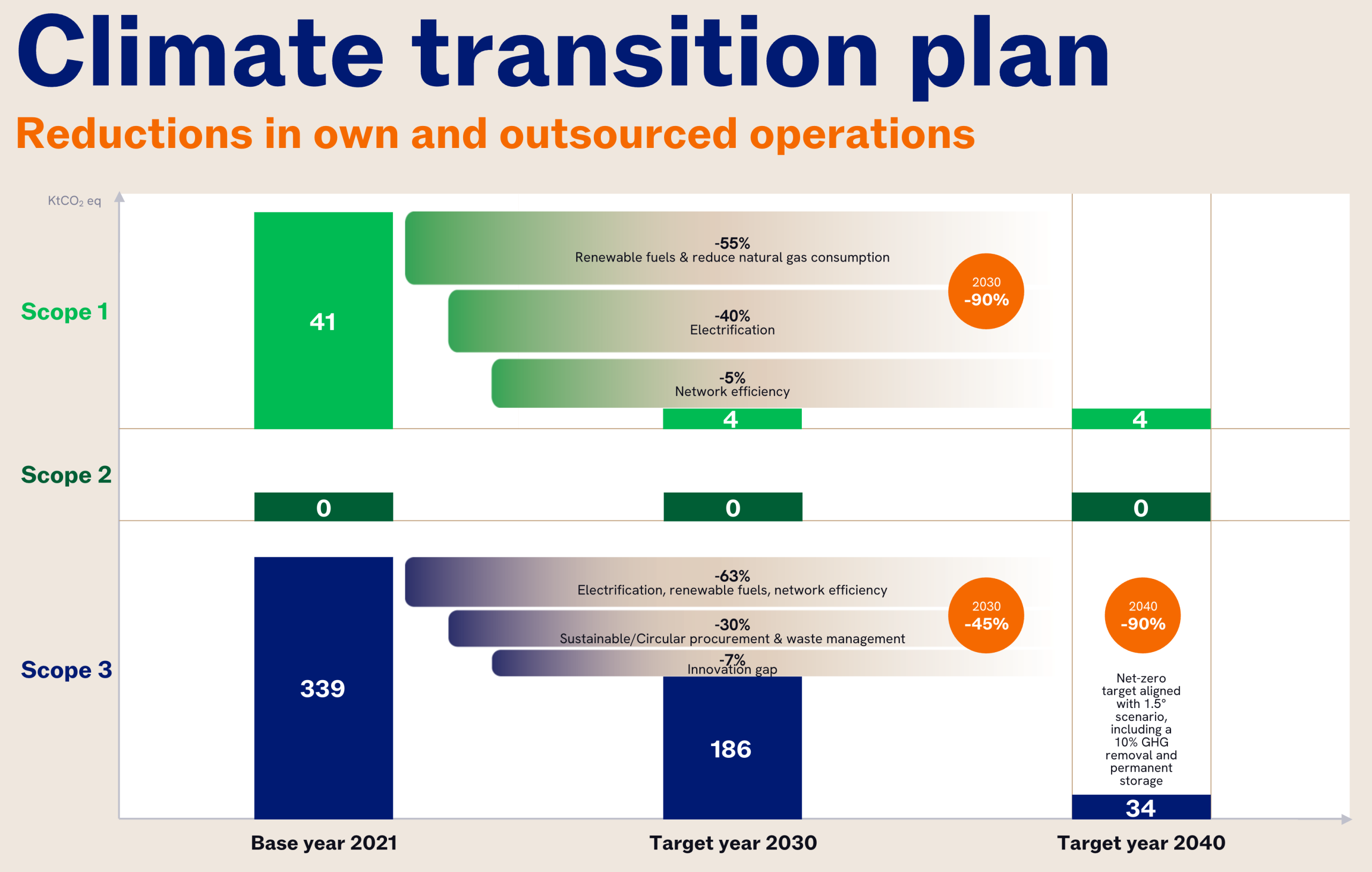
The climate transition plan describes PostNL’s decarbonisation strategy and key actions to achieve its GHG reduction targets. The figure on the next page illustrates how different decarbonisation levers contribute to achieving PostNL’s 2030 and 2040 climate targets, based on the absolute emission levels of the 2021 base year and the corresponding target years.
The contributions shown reflect the relative impact of decarbonisation levers across scope 1, scope 2 and scope 3 on emission reductions between the base year (2021) and the target years (2030 and 2040). They provide insight into PostNL’s strategic prioritisation of mitigation actions, rather than a forecast of future emissions or a detailed operational delivery pathway.
Across all scopes, the indicative contribution of each decarbonisation lever is derived from the distribution of emissions in the 2021 base year. This approach provides a consistent, high-level approximation of the relative importance of different mitigation actions. As implementation progresses, the relative contribution of individual levers may change due to technological developments, regulatory changes, operational decisions and evolving market conditions.
Scope 1
Baseline scope 1 emissions in 2021 amounted to 41,081 tCO₂e, with a linear reduction pathway towards a 90% decrease by 2030, resulting in target residual emissions of 4,108 tCO₂e. The allocation of decarbonisation levers within scope 1, including fleet electrification, the use of renewable fuels, network efficiency improvements and fuel-switching from gas and oil is based on each category’s relative contribution to scope 1 emissions in the 2021 base year.
This allocation illustrates the order of magnitude and relative role of different mitigation actions within scope 1 and supports transparency on how PostNL intends to achieve its scope 1 reduction targets.
Scope 2
For scope 2, emissions reductions are primarily driven by the increased use of renewable electricity, energy efficiency improvements and optimisation of electricity consumption across buildings, sorting centres and other operational facilities. The relative contribution of these actions reflects the composition of scope 2 emissions in the 2021 base year and represents the main levers available to reduce emissions from purchased energy, in line with PostNL’s mitigation strategy.
Scope 3
Scope 3 emissions are addressed through grouped decarbonisation levers reflecting their relative contribution to scope 3 emissions in the 2021 base year. Approximately 63% of the indicative scope 3 emissions reduction is attributed to electrification, renewable fuels and network efficiency across the value chain, including collaboration with delivery partners and logistics optimisation. A further 30% is attributed to sustainable and circular procurement and waste management, reflecting supplier engagement and material efficiency measures. The remaining 7% represents an innovation gap, capturing anticipated future solutions that are not yet fully available or scalable. These groupings provide a high-level overview of PostNL’s strategic focus areas for scope 3 mitigation and are intended to support understanding of the transition plan, rather than to define a fixed or exhaustive implementation pathway.
“Decarbonisation levers guide PostNL’s climate transition towards its 2030 and 2040 GHG reduction targets”
2.1.3 Our governance
More information on the integration of sustainability-related performance, specifically our GHG emissions, incentive schemes can be found on page in the Remuneration report chapter.
2.1.4 Our policies
PostNL has established an environmental and procurement policy to prevent, mitigate and remedy environmental impacts, manage risks and pursue opportunities. Together, these strategies and key actions strengthen the execution of our transition plan and embed sustainability across our operations and value chain. They guide our transition to a low-carbon and circular business model and cover the topics climate change mitigation, energy efficiency, pollution prevention and resource use, supporting our ambition to achieve net-zero emissions by 2040.
Environmental Policy
Our Environmental Policy outlines the strategies and key actions we have in place to prevent, mitigate and remediate actual and potential environmental impacts, address risks and to pursue opportunities related to climate change mitigation, reducing pollution and circular economy. We take a comprehensive approach in line with the transition plan and decarbonisation levers disclosed earlier in Our strategy in this section.
The Environmental Policy integrates objectives for reducing GHG emissions, improving energy efficiency and expanding renewable energy. Furthermore, it covers pollution prevention which focuses on air quality, reducing nitrous oxides and particulate matter previously caused by combustion from fossil fuels through electrification of vehicles, at the same time circularity is promoted by reducing residual waste, increasing the use of recycled materials, and collaborating with customers on re-commerce and packaging return.
The Environmental Policy applies to all PostNL Group entities and its upstream and downstream value chain activities. It affects workers, customers, consumers and society. The Environmental Policy is internally and publicly available on our website. In 2025, no updates took place to the policy, which is monitored and discussed on a quarterly and annual basis by the relevant teams and their management and with the BoM with oversight by the ESG Director.
The management of GHG emissions, physical and transition climate risks and long-term decarbonisation pathways—including short-, medium- and long-term horizons—is further detailed in PostNL’s Climate Transition Plan, assessed in the Climate Risk & Resilience Assessment, scenario analysis and decarbonisation actions across the value chain, and managed via the Enterprise Risk Management and Business Continuity Plans. Options for neutralising residual emissions, including potential GHG removals, are explored as part of our long-term net-zero pathway towards 2040.
“PostNL has established an environmental and procurement policy to prevent, mitigate and remedy environmental impacts, manage risks and pursue opportunities”
Procurement Policy
Our Procurement Policy outlines the standards we expect from our suppliers. They must operate ethically, comply with applicable laws and regulations, and meet our sustainability expectations. Built on our Code of Conduct, the Policy provides a clear framework for responsible sourcing, ensuring suppliers contribute to PostNL’s sustainability goals and outlines the strategies and key actions we have in place to prevent, mitigate and remediate actual and potential environmental impacts, address risks and to pursue opportunities related to climate change mitigation and circular economy. For more information on procurement, see the Governance disclosures, including the Procurement Policy.